/Money Exchange in Korea — What Travelers Should Know
Understanding where and how to exchange money can save you time and fees during your trip.
1) Exchanging Money at the Airport (e.g., Incheon International Airport)
Pros
- Very convenient right after arrival
- Safe and easy process
- English support available
Cons
- Usually the worst exchange rates
- Higher service fees
Best use: Exchange a small amount for transport and immediate expenses.
2) Exchanging Money at a Bank (e.g., KEB Hana Bank, KB Kookmin Bank)
Pros
- Reliable and transparent rates
- Safe and official
- Receipt provided
Cons
- Slower process (waiting time)
- Limited English at some branches
- Not the best rates compared to exchange shops
Best use: If you prefer safety and official service over the best rate.
3) Exchanging Money at Private Exchange Shops in Myeongdong
Pros
- Best exchange rates in Korea
- Very fast service
- No passport copy in many cases
- Staff used to foreign travelers
Cons
- Need to travel to Myeongdong
- Cash only
- Must choose reputable shops
Best use: Exchange most of your money here for the best value.
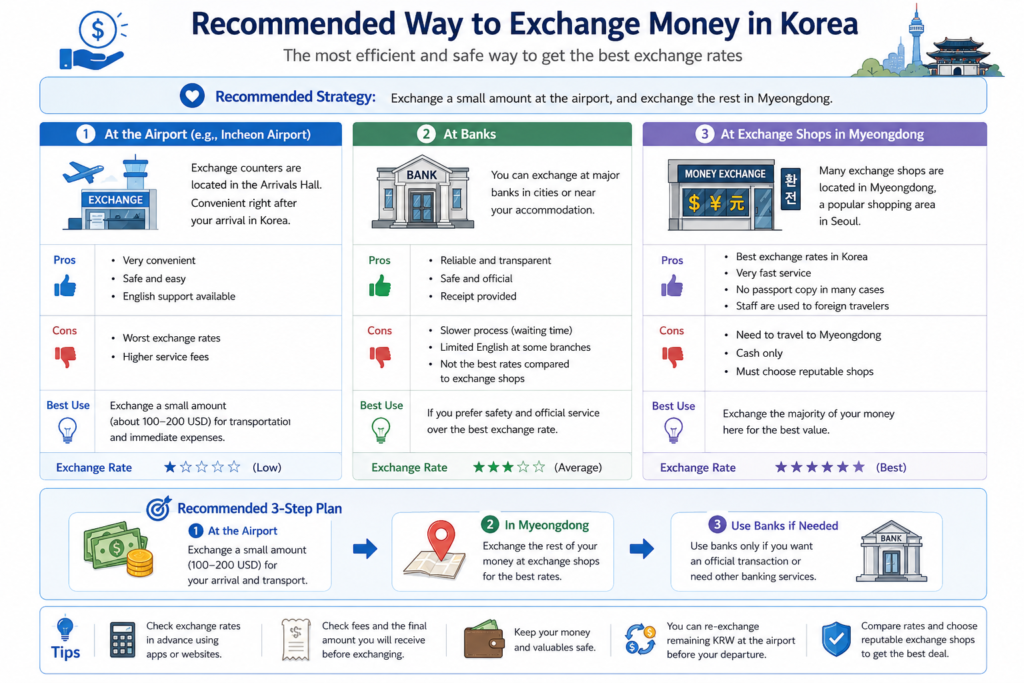
Smart Strategy
- Exchange a small amount at the airport.
- Exchange the majority in Myeongdong.
- Use banks only if you want official processing.
This approach minimizes fees and maximizes your travel budget.
Recommended Way to Exchange Money in Korea
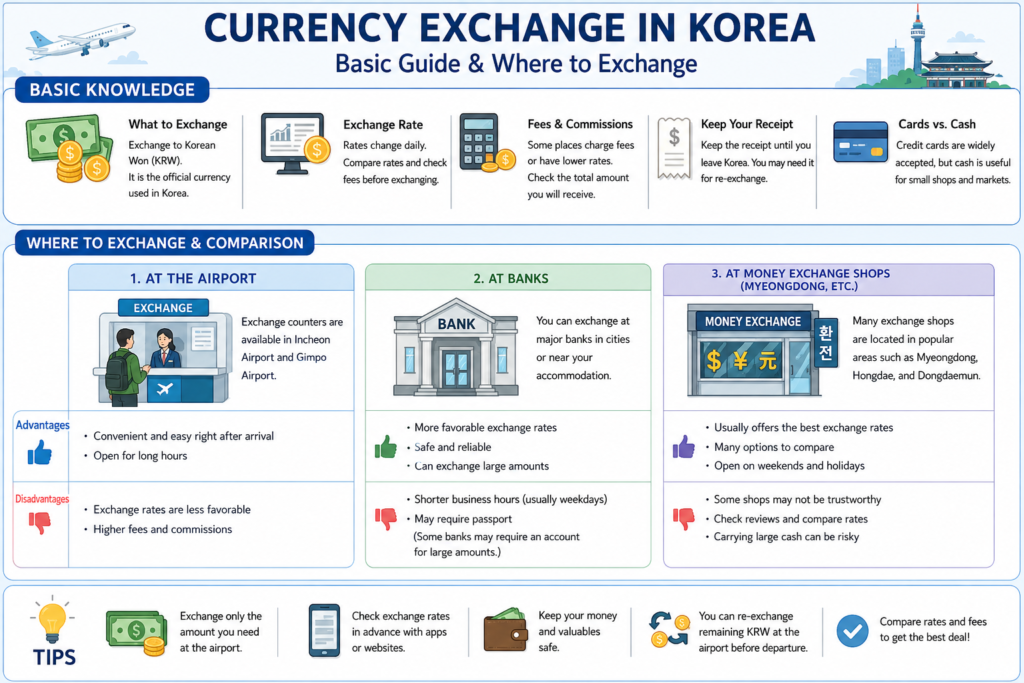
The smartest way to exchange money in Korea is to split your exchange into two steps:
- Exchange a small amount at the airport for transportation and immediate expenses.
- Exchange the majority of your money at reputable exchange shops in Myeongdong for the best rates.
Avoid exchanging large amounts at the airport due to poor rates, and use banks only if you prefer an official process over the best value.
This method helps you minimize fees and maximize your travel budget.
Transportation in Korea: From the Airport to Major Cities
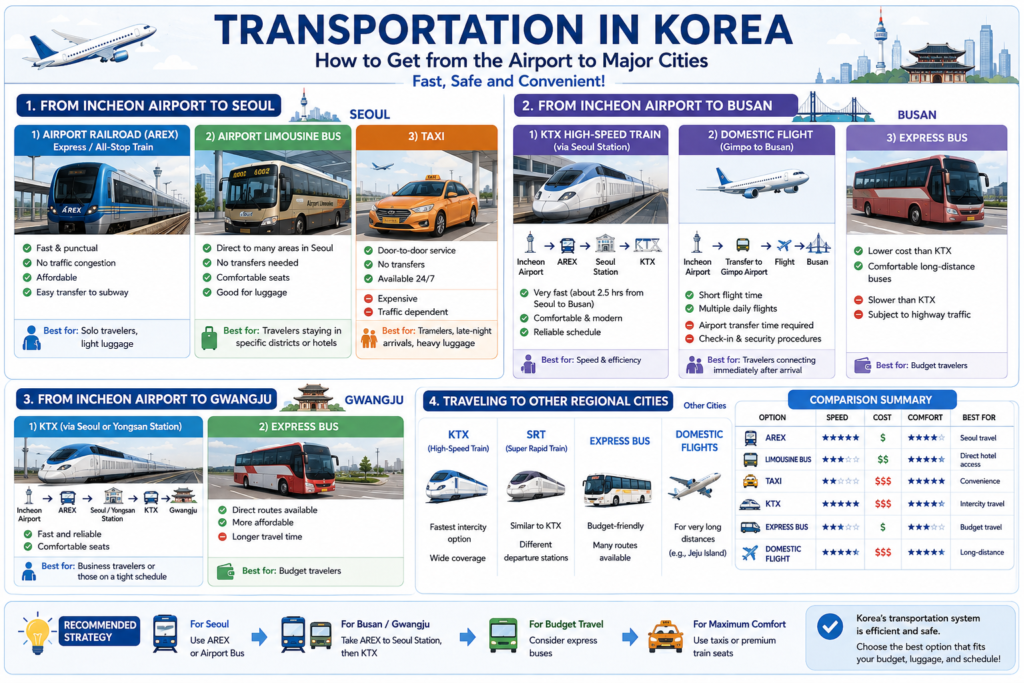
Korea has a fast, safe, and highly organized transportation system. Below is a clear guide on how to travel from the airport (mainly Incheon International Airport) to Seoul, Busan, Gwangju, and other regions, including the advantages of each option.
1. From Incheon Airport to Seoul
1) Airport Railroad (AREX)
What it is:
A direct train connecting Incheon Airport to Seoul Station.
Types:
- Express Train (non-stop)
- All-Stop Train (local)
Advantages:
- Fast and punctual
- No traffic congestion
- Affordable compared to taxis
- Easy transfer to subway lines at Seoul Station
Best for:
Solo travelers, light luggage, predictable travel time.
2) Airport Limousine Bus
What it is:
Comfortable buses connecting the airport to major hotels and districts in Seoul.
Advantages:
- Direct routes to many neighborhoods
- No transfers needed
- Comfortable seating
- Good for travelers with luggage
Best for:
Travelers staying in specific districts or hotels.
3) Taxi
What it is:
Door-to-door private transportation.
Advantages:
- Most convenient
- No transfers
- Available 24/7
Disadvantages:
- Expensive compared to train or bus
- Travel time depends on traffic
Best for:
Families, late-night arrivals, heavy luggage.
2. From Incheon Airport to Busan
1) KTX High-Speed Train (via Seoul Station)
Method:
Take AREX to Seoul Station → Transfer to KTX to Busan.
Advantages:
- Very fast (about 2.5 hours from Seoul to Busan)
- Comfortable and modern
- Reliable schedule
Best for:
Travelers who want speed and efficiency.
2) Domestic Flight (Gimpo to Busan)
Method:
Airport transfer to Gimpo Airport → Domestic flight to Busan.
Advantages:
- Short flight time
- Multiple daily flights
Disadvantages:
- Airport transfer time required
- Check-in and security procedures
Best for:
Travelers connecting immediately after arrival.
3) Express Bus
Advantages:
- Lower cost than KTX
- Comfortable long-distance buses
Disadvantages:
- Slower than KTX
- Subject to highway traffic
3. From Incheon Airport to Gwangju
1) KTX (via Seoul or Yongsan Station)
Method:
AREX → Transfer to KTX bound for Gwangju.
Advantages:
- Fast and reliable
- Comfortable seats
Best for:
Business travelers or those on a tight schedule.
2) Express Bus
Advantages:
- Direct routes available
- More affordable
Disadvantages:
- Longer travel time
4. Traveling to Other Regional Cities
Main Options:
- KTX (High-Speed Train): Fastest intercity option
- SRT (Super Rapid Train): Similar to KTX, departing from different stations
- Express Bus: Budget-friendly
- Domestic Flights: For very long distances (e.g., Jeju Island)
Transportation Comparison Summary
| Option | Speed | Cost | Comfort | Best For |
|---|---|---|---|---|
| AREX | Fast | Low | Good | Seoul travel |
| Limousine Bus | Medium | Medium | High | Direct hotel access |
| Taxi | Depends on traffic | High | Very High | Convenience |
| KTX | Very Fast | Medium-High | High | Intercity travel |
| Express Bus | Medium | Low | Good | Budget travel |
| Domestic Flight | Fast (air time) | Medium | High | Long-distance |
Recommended Strategy
- For Seoul: Use AREX or Airport Bus.
- For Busan/Gwangju: Take AREX to Seoul Station, then KTX.
- For budget travel: Consider express buses.
- For maximum comfort: Use taxis or premium train seats.
Korea’s transportation system is efficient and safe. The best option depends on your budget, luggage, and time schedule.